
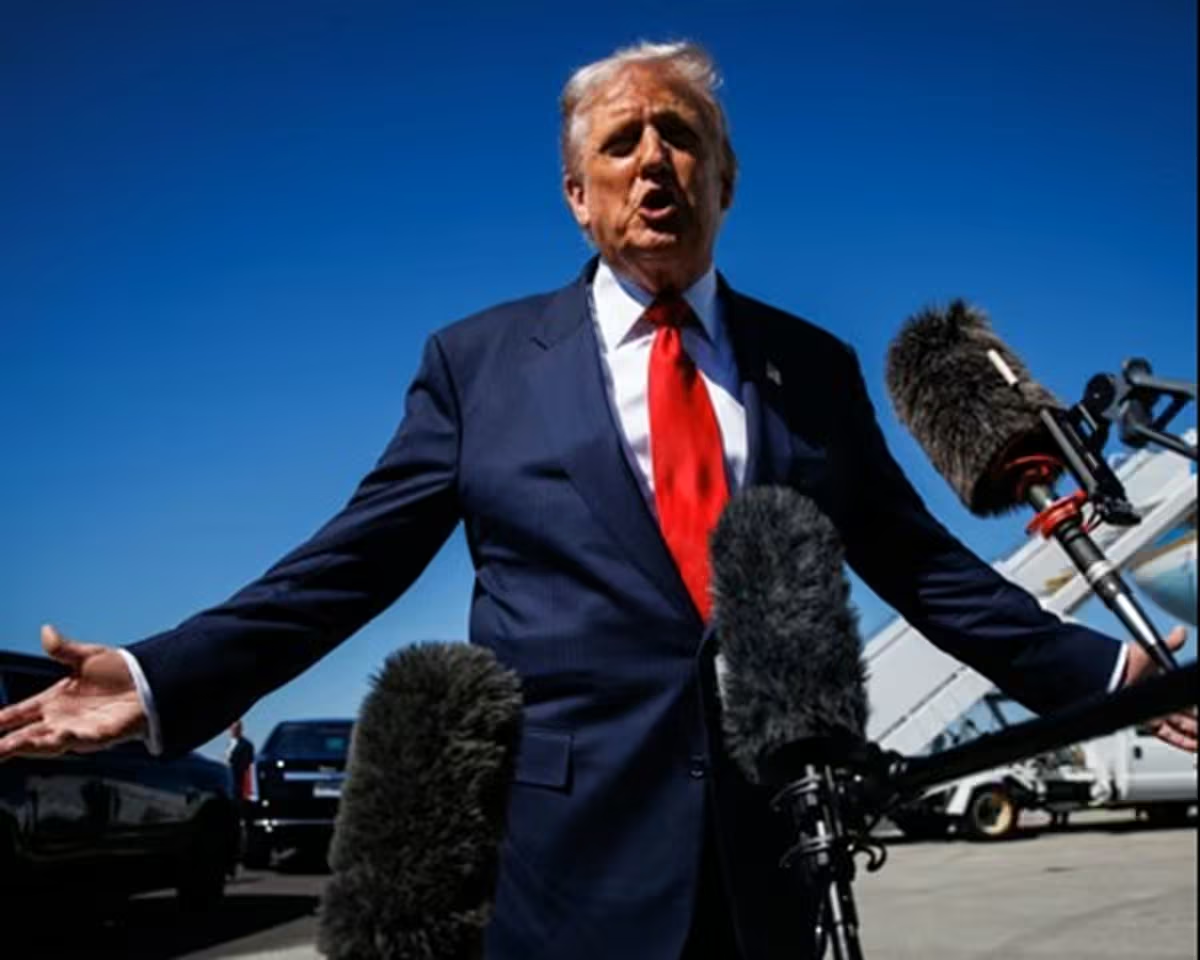
The United States (US) Congress is considering a bill The Nigeria Religious Freedom Accountability Act of 2025, sponsored by Republican Senator Ted Cruz, that could impose sanctions including in visa bans, asset freezes, and financial restrictions for Nigerian public officials and religious authorities accused of promoting or tolerating violence against Christians and other religious minorities.
This follows the designation of Nigeria as a Country of Particular Concern by the US President Donald Trump and his instruction to the Secretary of State, Marco Rubio, to act without delay.
On Friday, Trump, in a post on Truth, a social media platform, lamented that thousands of Christians were being killed in Nigeria and asked Congressman Riley Moore, together with Chairman Tom Cole and the House Appropriations Committee, to immediately look into the matter and report back to him.
In December 2020, the US Department of State designated Nigeria as a Country of Particular Concern for the first time ever due to what it termed systematic, ongoing, and egregious violations of religious freedom, violent Boko Haram attacks, and frequent ethno-religious conflicts exacerbated by the judiciary system.
Under the bill, introduced on September 9, 2025, the US Secretary of State will, within 90 days of its passage, submit a report to Congress listing Nigerian officials, including governors, judges, and monarchs who have “promoted, enacted, or maintained blasphemy laws” or “tolerated violence by non-state actors invoking religious justification.”
The sanctions, to be implemented under Executive Order 13818, the US government’s Global Magnitsky Human Rights Accountability framework.
One of the highlights of the bill is the implementation of Sharia law in northern Nigeria, which it termed the blasphemy law, and believed to be against the Christian population.
Sharia, derived from Islamic jurisprudence, has long existed as a system of personal, moral, and communal regulation among Muslim communities in northern Nigeria.
The major turning point came between 1999 and 2000, shortly after Nigeria’s return to civilian rule, when several northern states, beginning with Zamfara under Governor Ahmad Sani Yerima, expanded Sharia’s jurisdiction to include criminal law and public morality.
Within two years, about 12 northern states had adopted similar Sharia-based penal codes and established parallel Sharia courts alongside existing secular courts.
The affected states include Zamfara, Kano, Sokoto, Katsina, Bauchi, Borno, Jigawa, Kebbi, Yobe, Kaduna, Niger, and Gombe.
However, Kwara, Kogi, Plateau, Benue, Nasarawa, Taraba, and Adamawa, though with significant Muslim populations, still operate under the conventional secular legal system, with Sharia limited only to personal status matters such as marriage, inheritance, and family issues for Muslims, rather than criminal or public law.


Leave a Reply